Update on September 11, 2026:
Inbox Monster's Reputation reporting has been redesigned to factor in all the data points from Google Postmaster Tools (GPT) v2. The result is a single, consistent reputation grade across Google, Microsoft and Spamhaus, plus much deeper Gmail diagnostics than we could surface before.
As we discussed in previous updates, the biggest change is the scale. Reputation is now reported in three bands—High, Medium and Low—everywhere in the platform.
GPT v2 reports in these three bands natively. To keep a single, comparable scale across every source, we map the others onto it:
- Microsoft SNDS grades map directly to High / Medium / Low.
- Spamhaus grades map directly, with one exception: Anything Spamhaus reports as Bad is rolled into Low.
If you were connected to Postmaster Tools before this release, you'll need to re-authorize your connection against the v2 API.
Connecting takes just a minute, so please review our help center article for step-by-step instructions and more information about the latest reputation reporting changes.
Update on August 20, 2026:
When we first reported on the changes to Google Postmaster Tools (GPT) in October 2025, Google postponed deprecating its v1 dashboard. Google never set a firm deprecation date, but it looks like RIP-utation Day, as we call it, is here.
The message depicted below has been at the top of the v1 GPT since October 2025, but it remained accessible and was passing API data until this week.

Over the past month, we've seen a few data lags and v1 API connection issues that indicated changes were being made and the potential final sunsetting of the legacy dashboard.
Recently, the link to v1 has been redirecting to the v2 Compliance Dashboard. Inbox Monster is still receiving v1 Reputation data via the API through August 17 (two days is typical for GPT data delays, so this feed may have ended as well).
At Inbox Monster, we are keeping close tabs on the ongoing changes and working on bringing Google Postmaster Tools v2 data into the platform. We’ll continue updating this post with the latest information. Stay tuned!
What to Expect With GPT v2
So what’s the difference between v1 and v2 of Google Postmaster Tools?
The v2 API launched as a Developer Preview beta on December 20th, 2026, and became Generally Available on February 3rd, 2026 (Gmail API Release Notes).
At the time of publication, the main v2 Compliance Dashboard states, “Last updated on Wed, 5 Aug, at 17:00.” Feedback Loop data is up to date through August 15, 2026. Spam, Authentication, Encryption, and Delivery Error data appears to be up to date through August 18, 2026.
Google has been slowly adding features to the dashboard, the most recent being a “Deliverability analysis,” which gives valuable insight into why Gmail may be filtering or blocking your email.
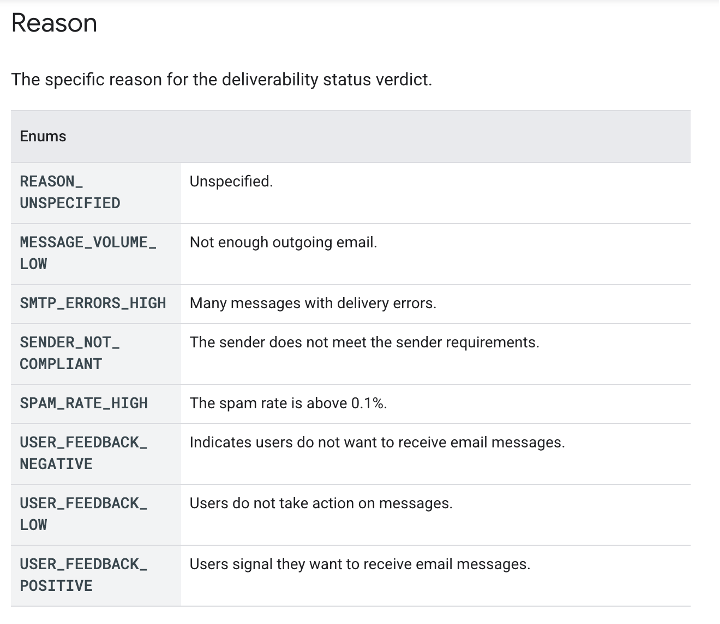
Here’s an example of a “User Feedback Positive” deliverability analysis:

Additionally, GPT offers specific reasons for a deliverability status verdict. Although v2 no longer includes Reputation tiers, these reasons, such as spam rate and user feedback, underpin a brand’s overall sender reputation.
The team at Inbox Monster has always touted that reputation has never been a single KPI, but rather a comprehensive understanding of a sender’s practices.
The right deliverability partner can not only assess the data provided by GPT and other mailsystems, but also offer strategic recommendations to improve your inbox placement and the health of your email program.
Learn how our expert services team can provide the proactive deliverability support you need and reach out to receive a custom demo of the Inbox Monster platform.
Original post on October 1, 2025:
Happy “No Gmail Reputation Day” to all who celebrate! Like many email geeks, we have mixed feelings. But we ultimately know that by monitoring a wide variety of inbox signals and following best practices, most in our circle will be just fine–even trading up eventually.
To us, “chasing the colors” of Reputation tiers was a reward for putting in the work on paying attention to subscriber behavior and implementing better sending practices. For the most part, inbox placement rates vs. spam folder placement have consistently been closely aligned in our seeded inbox tests across clients.
So It Goes…
But let us back up for those who missed Google’s big announcement: As of September 30th, “you will no longer be able to access the old Postmaster Tools web interface (v1). The updated Postmaster Tools API will return data consistent with the v2 dashboards.”
Google goes on to report that a new v2 API will launch before the end of 2025 to replace the current API, stating, “We will be introducing new dashboards to provide senders with even more useful and actionable information.”
As email experts like Al Iverson succinctly stated, this update means that domain and IP reputation data (including the bad, low, medium, and high rankings in corresponding colors) are now retired and no longer available.
Gmail is telling us to pay more attention to complaint rates, which is a strong signal of sender reputation. That said, there have been so many times that this is counterintuitive since Gmail only reports complaints on emails that land in the inbox.
It can be challenging to explain to a sender that a low / 0% complaint rate (CR) in Google Postmaster Tools is not always a positive sign: If their reputation was reported as bad/low, we could go on the assumption that the CR was low because emails were going into the spam folder.
This Is Why We Can’t Have Nice Things
“A drop in domain reputation was always a strong signal that an aspect of a sender's program needed attention.” ~ Thom Porter, Sr. Deliverability Consultant at Inbox Monster
We have always relied on reputation data as a backup to get a more holistic picture of how Gmail viewed a sender instead of relying on complaint rates only.
Based on Google’s recent updates, Gmail’s v2 compliance dashboard considers authentication to be significantly more important than reputation now. We don’t necessarily agree with this—a sender can have all the required authentication in place and still have practices that don’t align with positive subscriber engagement, and still incur potentially high complaints.
Also, after reviewing a lot of feedback from peers in the deliverability space, the consensus seems to be that reputation charts were very helpful in communication with senders.
We’re finding valuable ways to use the v2 dashboard, such as the feedback loop complaint rates and finding patterns in what emails are causing spikes (recent examples: political-leaning subject lines from non-political senders, and higher complaint rates on the second email of the day from the same sender).
Our main take? We’re hoping Gmail replaces its reputation data with some other source of deliverability euphoria, because there is no better work-related feeling than helping to improve a client’s reputation over time.
It felt GREAT on September 1st to have a call with this sender:
.png)
.png)
.png)
According to its announcement, Google has insinuated that new data is in the works to share. So, ultimately, if Gmail is saying that reputation data is no longer useful or accurate, we guess we should listen!
The reality is, with the use of inbox placement testing and a variety of other signals we rely on today (both positive and negative), we already have a very strong sense of whether a sender is doing the right things or the wrong things to reach the subscribers’ inbox—with or without Google reputation data. New data, once available, will bring added transparency to senders’ relationship with subscribers.
We work day in and day out with senders to evaluate what works, and also doesn’t work, to reach the inbox at Google. All those experiences will continue to ring true.
Inbox Monster’s End Game
“This shift isn’t just a UI update—Postmaster Tools v2 will give senders more reliable data and modern APIs to guide smarter deliverability strategies. Think of it as trading in a flip phone for a smartphone—Postmaster Tools v2 is built for the modern inbox.” ~ Josie Garcia, Deliverability Principal at Inbox Monster
So what’s next? Even though Inbox Monster will no longer report on Google domain and IP reputation as of Google’s September 30th update, your Reputation tab in our platform will continue summarizing all other reputation data from providers (e.g., Microsoft, Spamhaus), including Google’s user-reported spam complaint data and delivery error data.
By the end of 2025, Google is expected to go live with a new API version of Postmaster Tools (v2), in which a variety of new deliverability and compliance signals will be made available to inform senders on their email deliverability and health.
While we await new API data from Google, Gmail and Google Workspace deliverability can continue to be assessed through your seed data for inbox placement rates and in conjunction with spam complaint, blocklist, spam trap and Google delivery error data found in our Reputation tab of the platform.
Our team is assessing what changes to make on our Reputation tab to adjust the user interface in light of Google’s API changes. More to come from us on this in the near future. As new API feeds become available with Google, we’ll be making additional data points available within our platform for your benefit as well.
For any questions about Google’s API changes, please don’t hesitate to seek our expert services by reaching us within our Help Center, at support@inboxmonster.com, or through your support team.
As always, when it comes to deliverability solutions, we’re by your side every step of the way.