Being an email marketer is hard enough, even before you consider the data privacy protections in each jurisdiction around the world. It’s understandable if the ins-and-outs of the regulatory landscape make you want to join Monstie under the bed.
But if there’s one thing we learned in 2018 during the enforcement of GDPR, it’s resilience. Now we need it, as France and Italy have enacted new rules on email tracking pixels.
This explainer dives into France’s CNIL and Italy’s Garante regulations, detailing how each defines consent collection and who’s affected by the rulings. Then, we’ll walk through the actions you can take today to remain compliant.
Disclaimer: This explainer is for general education purposes only and does not constitute legal advice. Please consult qualified legal counsel before altering any practices in your email program.
Need a refresher on tracking best practices? Check out our monster guide to email tracking pixels, so you can monitor email opens without losing your subscribers’ trust.
What to Know About the New EU Rulings
Email tracking pixels have been around for decades. These 1x1 transparent images embedded in email HTML have been the basis for email open reporting. They allow businesses to record data, such as timestamp, device type, email client and approximate location.
Now, France and Italy have defined email open tracking as a read/write operation on the recipient’s device, similar to how cookies are categorized. This means senders must gain consent for mailboxes opened in those countries, save for a few narrow exceptions.
Here’s each country’s rule in one sentence:
- France’s CNIL (Commission Nationale de l’Informatique et des Libertés): Before you put a tracking pixel in an email to someone in France, you need their consent—unless the pixel does nothing except measure deliverability within strict limits, or help secure that person’s own login.
- Italy’s Garante (Garante per la protezione dei dati personali): In Italy, individual-level open tracking is prohibited outright—unless it is technically needed to send the message, needed for something the person actually asked for, or the person gave informed consent beforehand.
For most email marketers today, their middle name is “consent,” not trouble. Staying on the right side of the law is par for the course.
And even if a select few wanted to weasel out of their responsibilities to their recipients, these EU rulings make that pretty much impossible. As you can see in the table below, there is no configuration in which you can avoid collecting consent that clearly satisfies both France and Italy.
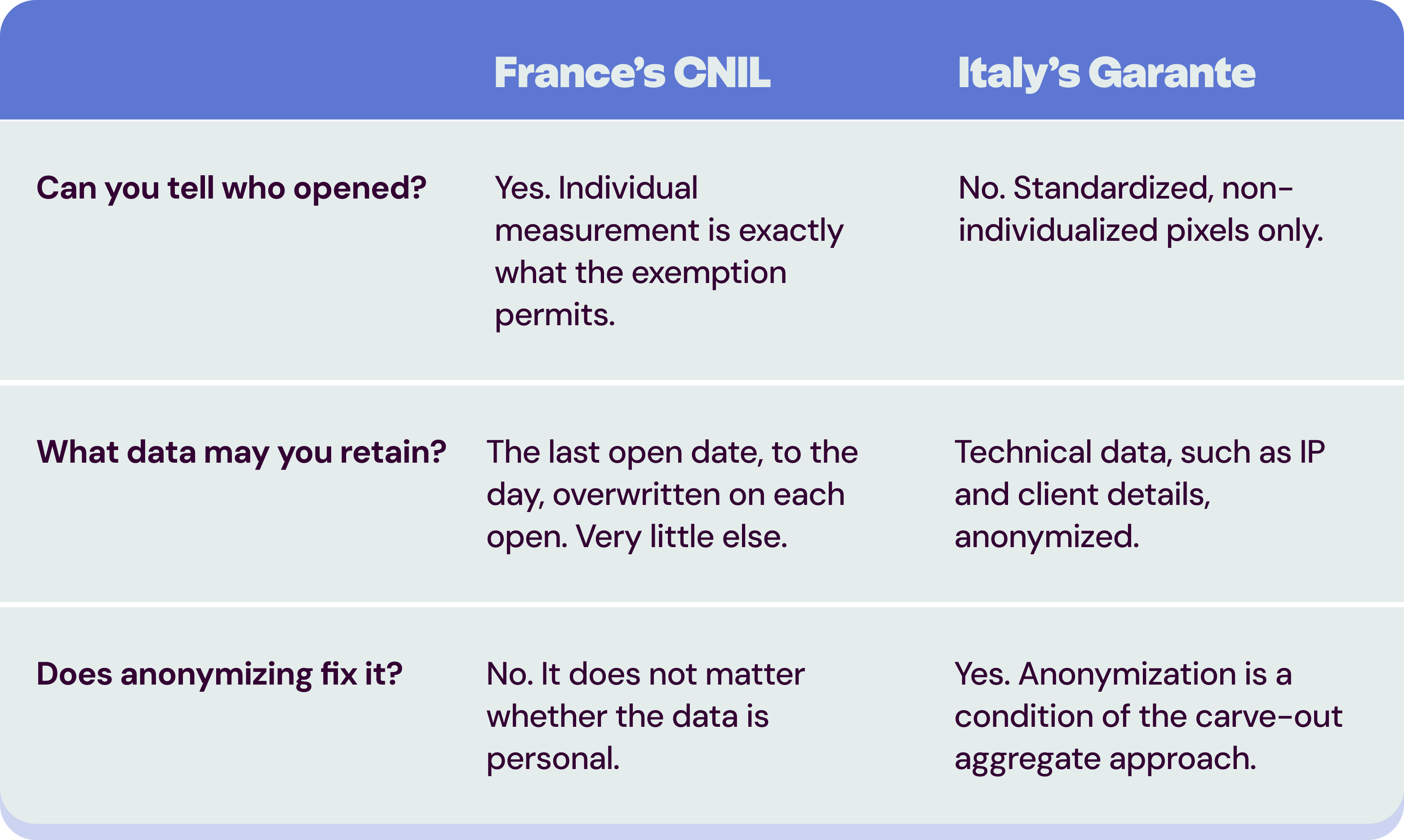
CNIL published its recommendation in April 2026, and enforcement is now live as of July. Garante guidelines were also adopted in April 2026, with a six-month compliance deadline of October 29, 2026.
“At this point, you’re probably wondering whether email tracking pixels are worth it. That’s fair! Deciding whether to enable or disable tracking is a decision every team should consider carefully. And it’s the responsibility of email technology providers to make the right path forward possible.” ~ Pilar Bower, Sr. Deliverability Consultant at Inbox Monster
Who Do The EU Regulations Apply To?
These regulations govern where a mailbox is opened, regardless of where the brand, the ESP or the pixel server sits. This means any business with recipients in France or Italy must comply with the respective rulings, even if it's entirely based in the U.S.
(Yep, that means Americans opening their email in these countries counts too.)
No exceptions are made for the following either:
- B2B addresses. Email addresses are in scope as soon as they are personal in form, so any firstname.lastname@company still applies.
- Charities and nonprofit organizations. These rulings include no sector carve-outs, so the same consent requirements apply as for commercial senders.
- Anonymous or aggregate-only pixels. Older EU directives were not built on the notion of personal data, so anonymizing the payload does not remove the obligation.
How Is Consent Defined and Collected?
Because email tracking pixels read or write on the recipient’s device and their purposes are rarely considered exemptions, consent is required. Consent to receive an email is not automatically consent to track an email.
Consent has a specific legal meaning. It has to be:
- Freely given: No penalty for saying no
- Specific: One choice per purpose
- Informed: The recipient knows who is tracking and why
- Unambiguous: Must be a deliberate act
- Collected first: Before any pixel is sent
- Easy to withdraw: As easy as it was to give
- Documented: You can show when and how
Based on this definition, none of the following count as consent:
- A pre-ticked box
- Bundled into terms and conditions
- Buried in a privacy policy
- The act of continuing to use the service
- Silence
For most email marketers, it’s not the understanding of consent that’s the challenge—it’s collecting consent in the first place.
Email service providers (ESPs) typically manage open tracking consent through default behavior settings (disabled, opted in, or opted out) and user-level attributes (consent granted or denied).
Customer.io has a detailed guide on how it tracks consent, but we recommend consulting your specific ESP to determine exactly how consent is collected and managed.
The Impact on Email Metrics
Now that you know what these two EU rulings govern, here’s how they will (and won’t) affect your email reporting.
- Open rates become a partial sample. Opens have already become less reliable due to Apple Mail Privacy Protection (MPP) and Gmail caching, but for recipients in France and Italy, opens are logged only for consenting or exempt users. Your blended global open rate will likely dip because of a smaller sample, not weaker engagement.
- Clicks and complaints still work—for now. Click tracking is a separate mechanism reflecting a specific action, so CTR and complaint rate remain usable where opens are gated. However, CNIL has signposted that tracking links likely carry similar obligations, so do not build the long-term fallback on clicks alone.
- Inbox placement is untouched. Google Postmaster Tools, Microsoft SNDS and spamtrap hits are computed by the mailbox provider from its own inbox data, not from anyone’s pixel.
- Trend lines will be fractured. Any French or Italian time series spanning the change will show a discontinuity based on consent coverage rather than user behavior.
And here’s a risk that deserves its own call-out: Engagement-based list hygiene may do real damage.
Sunset and re-engagement rules, such as “no opens in X sends,” cannot tell a disengaged contact from an untracked one. You don’t want to suppress perfectly good addresses on the basis of missing data and read it as churn.
For affected segments, now is the time to swap “no opens” triggers for click- or send-based cadences. Make sure you’re suppressing on explicit signals—never on the absence of data.
“The reliability of open data has already eroded in recent years as consumer privacy protections have been strengthened. This is a good thing for email recipients, and rulings like these in the EU push senders into complying with best practices.” ~ Pilar Bower, Sr. Deliverability Consultant at Inbox Monster
The 5 Moves to Make to Your Email Program
- Decide whether to continue tracking. Because even vacationers are impacted by these regulations, it’s safe to assume most recipients on your list will need to provide consent. Whether the value of email open tracking outweighs the challenge of consent collection will be subjective based on your business practices.
- Footnote FR and IT open rates as a consented sample. When reporting out on metrics, caveat any visible dips as reduced coverage rather than failing engagement or a deliverability fault.
- Use the tracking toggles your ESP already has. Most sending platforms expose per-send or do-not-track switches. Mapping consent status onto those is an interim control that’s available today.
- Re-baseline sunset and re-engagement rules. As mentioned in the previous section, swap “no opens” triggers for click- or send-based cadences on affected segments, so hygiene rules stop suppressing good addresses on missing data.
- Get your DPO to sign off on consent wording. GDPR required organizations to appoint a Data Protection Officer (DPO), so work with yours to ensure compliance.
Inbox Monster’s Role in Email Pixel Tracking
It’s important to note that complying with these new regulations is a duty of the sender. That said, senders can comply only if their email tools make it possible.
As a processor under these rulings, here are the responsibilities of Inbox Monster:
- We act on explicit instructions to process data compliantly.
- We provide compliant product controls so clients can successfully operate within regulatory environments.
- We have an obligation to flag unlawful data use, as we could be held liable for noncompliance as well.
- We document and follow the consent lifecycle, so our technology can properly handle that information once received.
To learn more about Inbox Monster’s privacy policies and compliance documentation, please visit our Trust Center.
Tracking the Latest EU Pixel News
Keeping up with data privacy and security rulings around the world can be overwhelming, especially when you’re just trying to plan your next send.
The good news? You don’t have to do email alone. We’ll keep this post updated with the latest EU pixel news, and we’re here to help you navigate the transition.
Contact our team of email experts to get started.
{{expert="/blog-ctas"}}
FAQs About EU Email Pixel Tracking
What is the deadline for France’s CNIL?
The deadline has already passed for France’s CNIL, which was published on April 14, 2026. It is now in force as of July 14, 2026. Any sender that has not yet sent its information email is past the three-month deadline.
CNIL allows tolerance where send volume made staggering necessary, but only if the constraint is documented. Segment French recipients and restrict the pixel where consent is absent.
What is the deadline for Italy’s Garante?
The Italian deadline is October 29, 2026. After that date, email tracking pixels must be in aggregate-only mode for Italian recipients.
How can I comply with the EU rulings on email pixel tracking?
To prepare for enforcement of these EU regulations, record consent status as a field for each recipient on your mailing list, establish regional pixel profiles and document each purpose for email pixel tracking.