Did you hear the news? Inbox Monster now has an advice column for email marketers! We’re excited to bring you our first submission—and it’s a super juicy one.
If you’d like to ask Monstie about deliverability dilemmas, creative rendering conundrums or other email issues, please send us your questions.
{{ask-monstie="/blog-ctas"}}
Now, without further ado, let’s introduce our first question:
Hello Monstie!
I’m truly struggling, ya see. I have some friends who are sending cold emails to people who never consented to receive them. They think it’s okay because those email addresses might be “interested.” Oh jeez. How do I tell them that this isn’t good for your deliverability? I need your help, Monstie.
Thanks, Egg Boy
We appreciate your concern, Egg Boy! Cold email is no laughing matter. Even if your brand is behaving ethically in the inbox, bad senders bring down the entire email marketing industry. It benefits all of us when everyone holds themselves to the highest standards.
To answer your question on how to hold your colleagues accountable, let’s define cold email and explain the consequences of engaging with unconsenting recipients.
What Is Cold Email?
Before we list the risks of cold emailing, we need to be on the same page as to what the practice entails. According to M3AAWG, whose mission is to prevent online abuse, cold email communications are defined as such:
“In email marketing terms, a ‘Cold Email’ is an unsolicited email from otherwise legitimate, identifiable senders that tries to create a business relationship, a sale, a business opportunity, or other professional benefit from a recipient who has no prior relationship, connection, or consent with the sender or business.”
In other words, if a warm email is one sent to a willing and engaged recipient, then a cold email is spam, plain and simple.
Are Cold Email and Spam Really the Same Thing?
Various jurisdictions and the legislation they enact address spam differently, but it’s not only your country’s laws that dictate which emails land in the inbox. Mailbox providers, blocklists and advocacy organizations unite to ensure online trust and safety.
Spamhaus, the trusted authority on IP and domain reputation, uses the industry standard definition of spam as Unsolicited Bulk Email (UBE):
“Therefore, anyone sending UBE on the Internet, regardless of whether the content is commercial or not, illegal or not, is a sender of spam—and thus a spammer.”
That sentence is worth reading again. Regardless of what’s technically legal, inbox karma will come for you if your recipients’ best interests aren’t your top priority. Senders branded as spammers will face major consequences.
Let’s get clear on what those are.
What Are the Consequences of Cold Emailing?
Frequent cold emailers risk the wrath of the email community at large. Here’s what typically can occur:
- Lower inbox placement and sender reputation. ISPs like Gmail, Microsoft and Yahoo use behavioral signals (e.g., opens, clicks, replies) to judge sender legitimacy. Repeatedly sending to users who don’t engage tells mailbox providers that the sender’s content is unwanted. Over time, this can significantly damage your sender reputation and reduce your inbox placement—even for engaged recipients.
- Increased spam complaints. If they never opted in to email communications, frustrated recipients will report messages as spam. Too many negative signals can result in automatic filtering to the spam folder, regardless of authentication setup or content quality.
- Blocklisting. Persistent, unengaged sends can lead to blocklist inclusion, which affects all email communications. Spamhaus’ anti-spam blocklist, for instance, protects more than 4.5 billion user mailboxes, so earning a spot on this list is a prize that no legitimate business wants to win.
- Compliance violations. Under certain regulations, unlawful persistence or harassment can result in severe penalties. Noncompliance with the CAN-SPAM Act is subject to fines of over $53,000 per violation (that’s for each separate email). Serious infringements of the GDPR could result in fines of up to €20 million, or 4% of a company’s worldwide annual revenue from the preceding financial year, whichever is higher.
- Brand damage. Repeated, irrelevant emails erode trust and harm credibility with customers, prospects and partners. Nobody wants to support a brand that doesn’t act with integrity.
What Are Some Best Practices for Re-Engaging Recipients?
Even if their users opted in to receive email communications, companies can still be affected by poor inbox placement and sender reputation if they continue to send unwanted or irrelevant messages.
Here are our dos and don’ts for re-engagement.
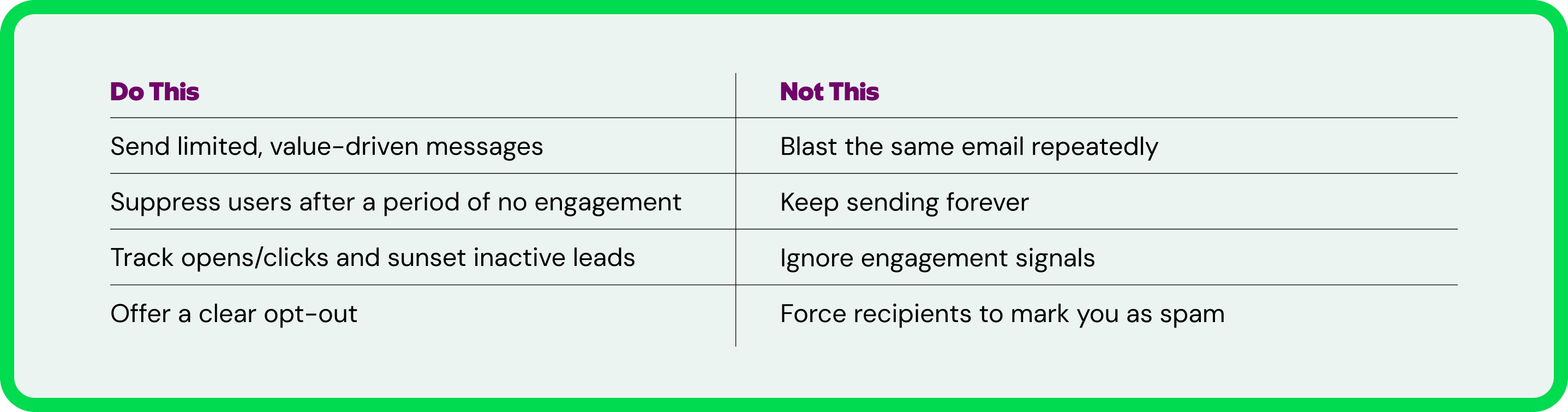
For a deeper dive on how to win back inactive subscribers and protect your deliverability, check out our Monster Guide to Re-Engagement.
But What About B2B Cold Email?
Most email marketers would agree that mass-blasting millions of unsuspecting consumers is a terrible practice. And yet, when it comes to sales organizations at B2B companies, cold emailing is often deeply embedded in the culture.
In an era where people direct-message strangers on LinkedIn without a second thought, what makes cold email different?
Despite the vast number of data scraping vendors offering mailing lists for sale or rent, this practice violates the terms of use of email service providers. Both senders and ESPs can be held legally responsible for noncompliance, so spammers are not welcome on any platform. Uploading unsolicited email addresses can result in outright bans.
But even if all email addresses are acquired above board, so to speak, there’s a dicey gray area that organizations can enter if they’re not careful about honoring a user’s consent. Just because a prospect signed up for a demo or a contest giveaway doesn’t necessarily mean they want to receive marketing communications.
Sales and marketing teams should be explicitly clear with prospects on how their contact information will be used. Not sure if someone wants to hear from you? Ask! A double opt-in campaign can be a great way to confirm a new subscriber’s interest and preferences.
What’s not okay is when B2B cold email mimics one-to-one communications by deploying misleading delivery methods, lookalike domains or multiple sending accounts to try to bypass spam filter detection.
As a M3AAWG member, Inbox Monster agrees with the working group’s stance: “Using deceptive and misleading delivery methods to send unsolicited email (including Cold Email) is an abusive practice.”
Regardless of the nature of a business, emailing users en masse without their explicit consent is spam. Hard stop.
A Rising Tide Lifts All Boats
To return to your question, Egg Boy, you must see good intentions in your cold emailing friends, so here are some cheeky scripts you can try using to steer them on the right path:
- Consent is attractive! You’re way more good-looking when you email with explicit permissions. It’s science.
- Imagine the coolest person you know. Does Pedro Pascal cold-email people? I didn’t think so.
- It only takes five minutes to annoy somebody. But it will take them five years to forget about it. Or so I’ve heard.
We’re not experts in negotiation, of course, but we hope we’ve offered sound advice. As any goodhearted email marketer, like Egg Boy, can attest, one of the best parts of participating in the email community is the support we give one another.
Outsiders looking in are quick to make snap judgments and label even wanted, opted-in marketing communications as spam. So it behooves us to fiercely guard the line between legit senders and bad actors.
If you know of any teams or organizations that continue to cold email, do us monsters a favor and send them this blog post. If we can convince even one business to reconsider, then inboxes everywhere will be better for it.
Got a burning question for the Inbox Monster team? Submit this form, and you may find it featured in a future Ask Monstie column!
{{ask-monstie="/blog-ctas"}}