We’re on a mission to make Ask Monstie the juiciest advice column for email marketers, and thanks to you, we’re just getting started. Our first installment laid down the law on cold emailing, and today we’re diving into more divisive territory: the importance of sunset policies and why you should say goodbye to inactive subscribers.
Struggling with an email issue of your own? Submit your question to us, and you may be featured in a future Ask Monstie feature.
{{ask-monstie="/blog-ctas"}}
Alright, let’s hear what’s on the mind of today’s email geek:
Hey Monstie,
I’m having a hard time justifying why our company should sunset users after a specific timeframe of inactivity. Email’s such a money-making channel for us, so my leadership is adamant that more users = better for the bottom line. Some folks are even under the impression that removing users from our mailing list without their permission is illegal! I know this is bad for our deliverability, but that doesn’t seem to outweigh the potential for more revenue.
Thanks for the advice, Riding Off Into the Sunset
Thanks for your question, Riding Off! We know how difficult it can be to convince leadership teams that quality matters far more than quantity when it comes to email subscribers.
To make your message more persuasive, let’s separate facts from fiction and discuss why sunset policies are an essential part of any email program.
What Is a Sunset Policy?
Just like a sunset marks the end of a day, a sunset policy establishes how to end a relationship with an email subscriber. At this point, a user has gone dark, and it’s time to say goodbye.
Sunsetting subscribers is not a decision to make lightly. In our Monster Guide to Re-Engagement, we explain that sunsetting is the last stage in the user lifecycle.
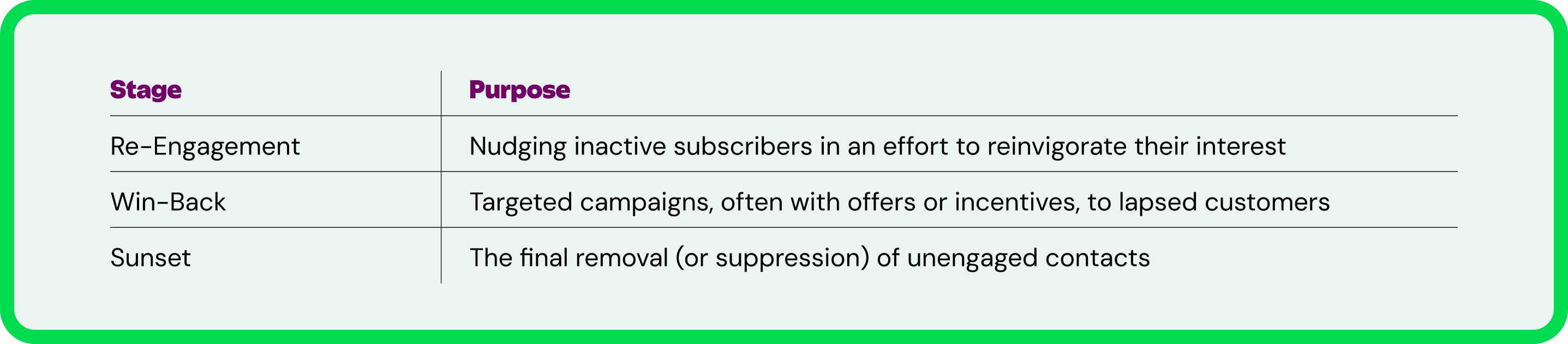
“When you map your lifecycle strategy, think of these as stages in a funnel: re-engagement first, win-back for the promising ones and sunset for the true ghosts.” ~ Laura Sullivan, Head of Brand & Marketing at Inbox Monster
When More Is Not Merrier
Marketers know how valuable email is as a channel, achieving up to 40x ROI. Naturally, then, a business aims to increase the size of its mailing list. More subscribers always means more money, right?
Not so fast.
We’ll put it bluntly: Bad things happen when email marketing is treated like a PEZ dispenser for leads. Maintaining a large list regardless of engagement will actually backfire. Because when a company is so obsessed with “number go up” that they ignore best practices, eventually those numbers will go way, way down.
The Negative Impact of Holding On
Sunset policies aren’t some kind of fun police, curbing your ability to contact subscribers for no reason. They’re a safeguard to protect your sender reputation.
When you repeatedly email people who haven’t shown any interest in months (or years), these are the consequences you can expect:
- Poor list hygiene. Inactive contacts are dead weight, bringing down the quality of your mailing list before you even send a message. Removing hard bounces, typo-ridden addresses and unengaged users improves your chances of landing in the inbox for the people worth your time and attention.
- Higher spamtrap exposure. Like the clothes in the back of your closet, email addresses are often outgrown and abandoned. If your list hygiene isn’t squeaky clean, you’re more likely to hit spamtraps, which sends negative signals to mailbox providers and damages your reputation.
- Increase in spam complaints. Disengagement is often an early sign that your content isn’t targeted or relevant enough to keep people interested. As Spamhaus rightly put it: “The more unengaged your audience becomes, the more likely they are to mark your mail as spam.”
- Weaker inbox placement. When a big chunk of your list ignores you, ISPs like Gmail and Yahoo treat inactivity as disinterest. If enough subscribers go dormant, your whole program can be throttled or filtered to spam.
- Revenue loss. Inactive contacts actively harm your deliverability, which means removing them is an act of loss prevention. Every email that doesn’t land in the inbox is money that doesn’t land in your pocket. Improving engagement is one of the best ways to boost your company’s bottom line.
What Are Some Best Practices for Sunsetting Subscribers?
An effective sunset policy is one that is intentional and well-defined. Here are our recommendations to sending a proper goodbye:
- Monitor your deliverability. If you’re noticing unpredictable trends or negative signals, it’s usually a sign that the quality of your list should be attended to. Inbox placement testing tools like Inbox Monster can help you improve your deliverability and maximize your email program’s performance.
- Scrub that list clean. It’s time to get your Marie Kondo on and do some spring cleaning. Get rid of any bad addresses, spamtraps and hard bounces before you deploy your next campaign.
- Define what counts as inactive. For high-volume brands, that might be 30 days without an open or click. For others, the timeframe may be longer. 6-12 months of inactivity is a typical threshold, but the right cutoff for your business will depend on your audience and email cadence.
- Establish a re-engagement campaign. The best way to combat the energy vampires on your list is to prevent them from turning in the first place. A re-engagement campaign can help revive subscribers whose interest has lapsed and encourage them to take action.
- Remove the lost causes. Depending on your company’s policies, you can choose to delete these contacts outright or suppress them. Suppression allows you to retain historical data and maintain CRM records for non-email targeting, like ads or direct mail.
So, Sunsetting Is Not Illegal?
Far from it! Contacting your subscribers is a courtesy, not an ironclad obligation. You are not beholden to emailing users in perpetuity, regardless of whether they’re even listening.
Here’s what’s actually illegal in many jurisdictions:
- Cold emailing people who never consented to your marketing communications
- Not adding or hiding a way to unsubscribe
- Ignoring opt-out requests or not honoring a user’s right to removal
- Forgetting to include a physical postal address
- Using deceptive or misleading subject lines
And here’s what’s technically legal but shouldn’t be, in our opinion:
- Unsubscribing users after several days rather than immediately
- Making people navigate an archaic web portal just to opt out
- Sending an apology or “oops” email that’s yet another promotion
- Forgetting to design an email for Dark Mode
- Inaccessible, image-only emails
- Using tired cliches like “no tricks, only treats” during Halloween
- Promoting anything as “last chance” when you know that sale will be extended three more times
Quality Over Quantity
You know what else should be illegal? Forcing good-intentioned email marketers like you, Riding Off Into the Sunset, to keep sending to an artificially inflated list at the risk of your deliverability. Shrinking a list may sound like a bad thing, but your engagement rates will improve—and that’s a more important metric anyway.
So yeah, when it comes to mailing lists, you can tell your boss that size isn’t all it’s cracked up to be.
And if you need a deliverability platform to prove that point, you’re welcome to reach out and book a demo of Inbox Monster.
Got a burning question for the Inbox Monster team? Submit this form, and you may find it featured in a future Ask Monstie column!
{{ask-monstie="/blog-ctas"}}